Home Assistant maintenance at professional scale. No VPN, no on-site visits.
Look after every customer's Home Assistant installation from one dashboard. Status at a glance, updates on demand, maintenance at the click of a button. And your customer stays in control at all times.
This is what running it looks like.
Real views from app.ha-fleet-manager.com, no render and no mockup. Exactly the interface you use to look after your Home Assistant instances every day.
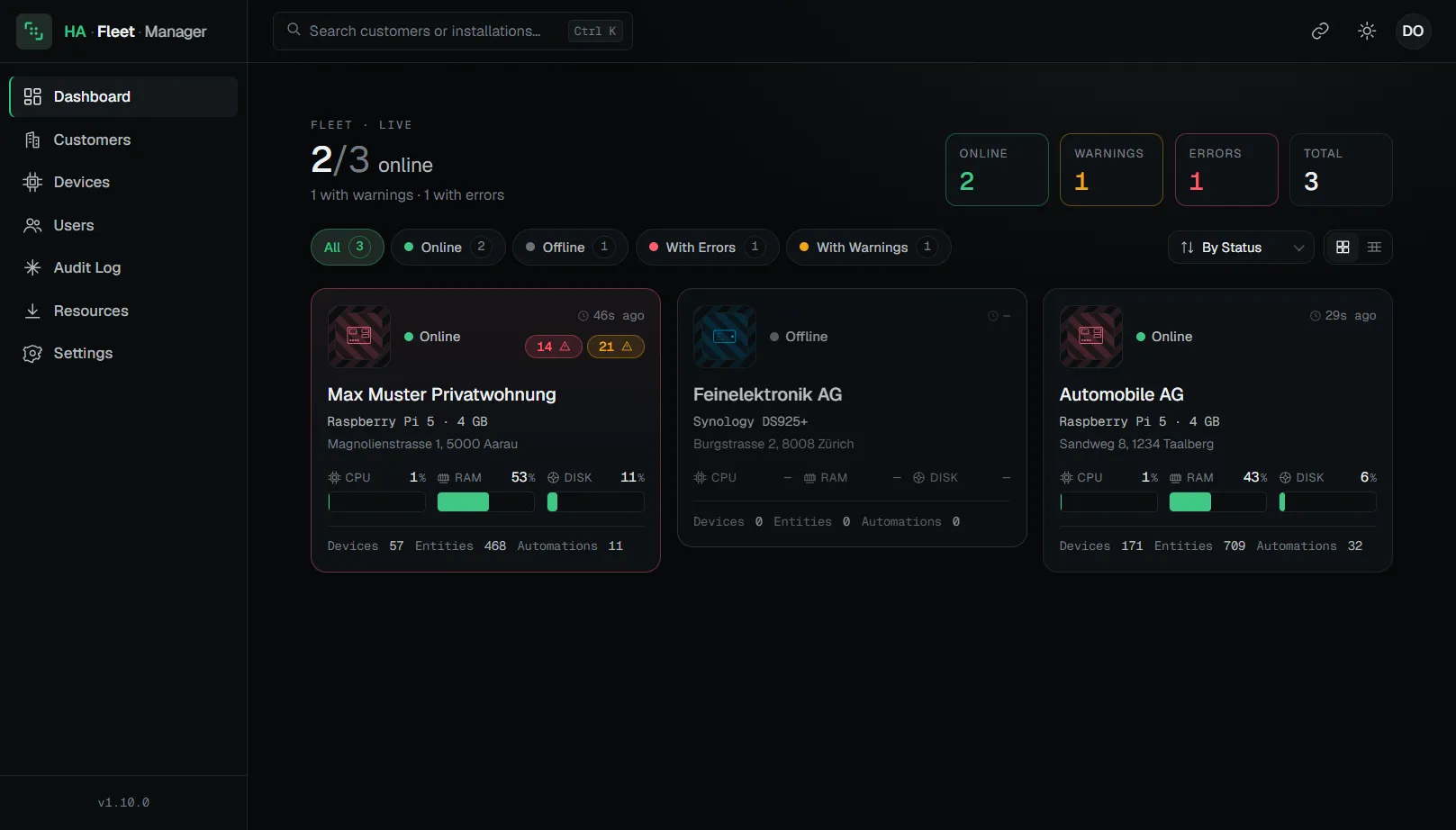
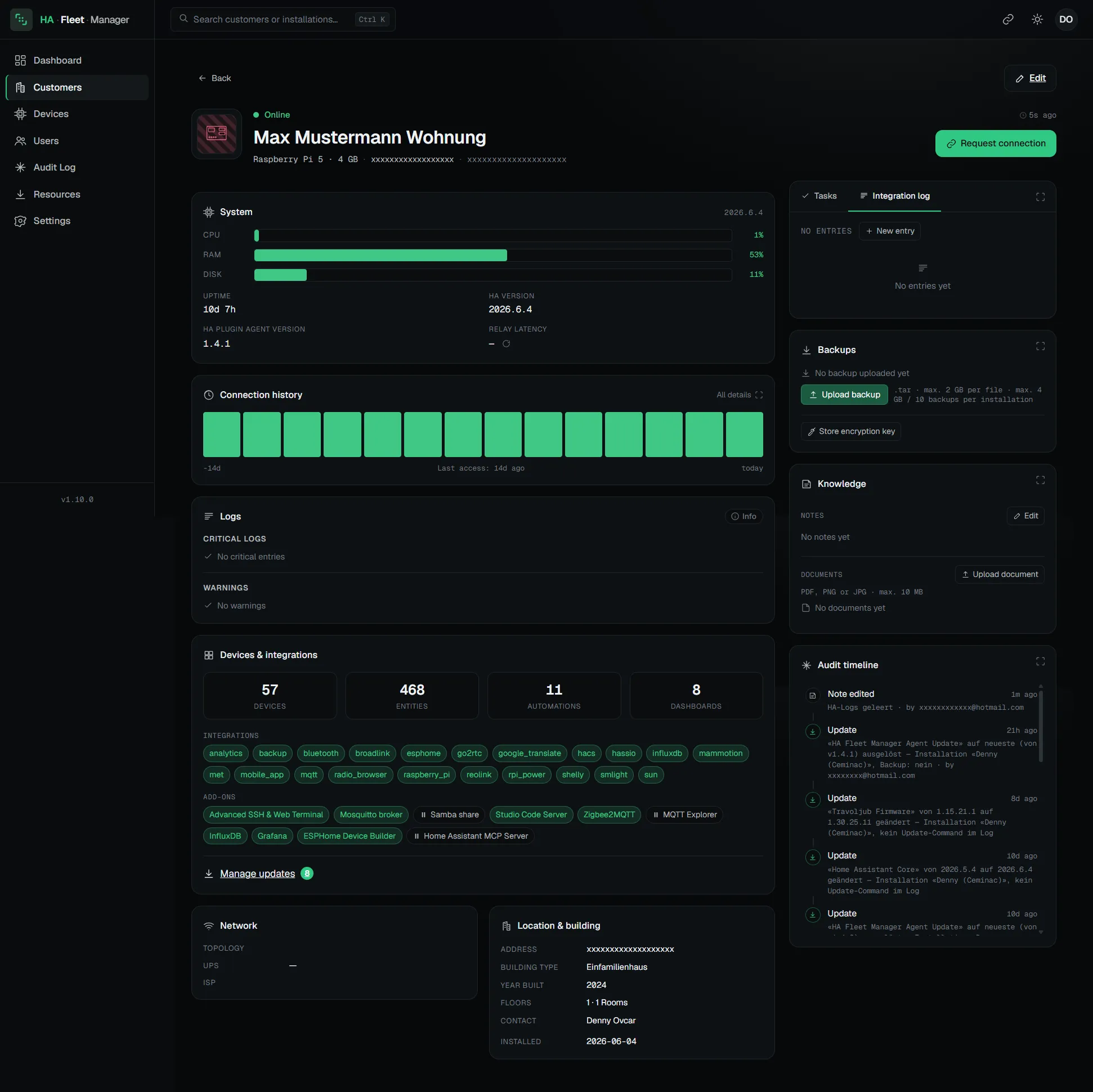
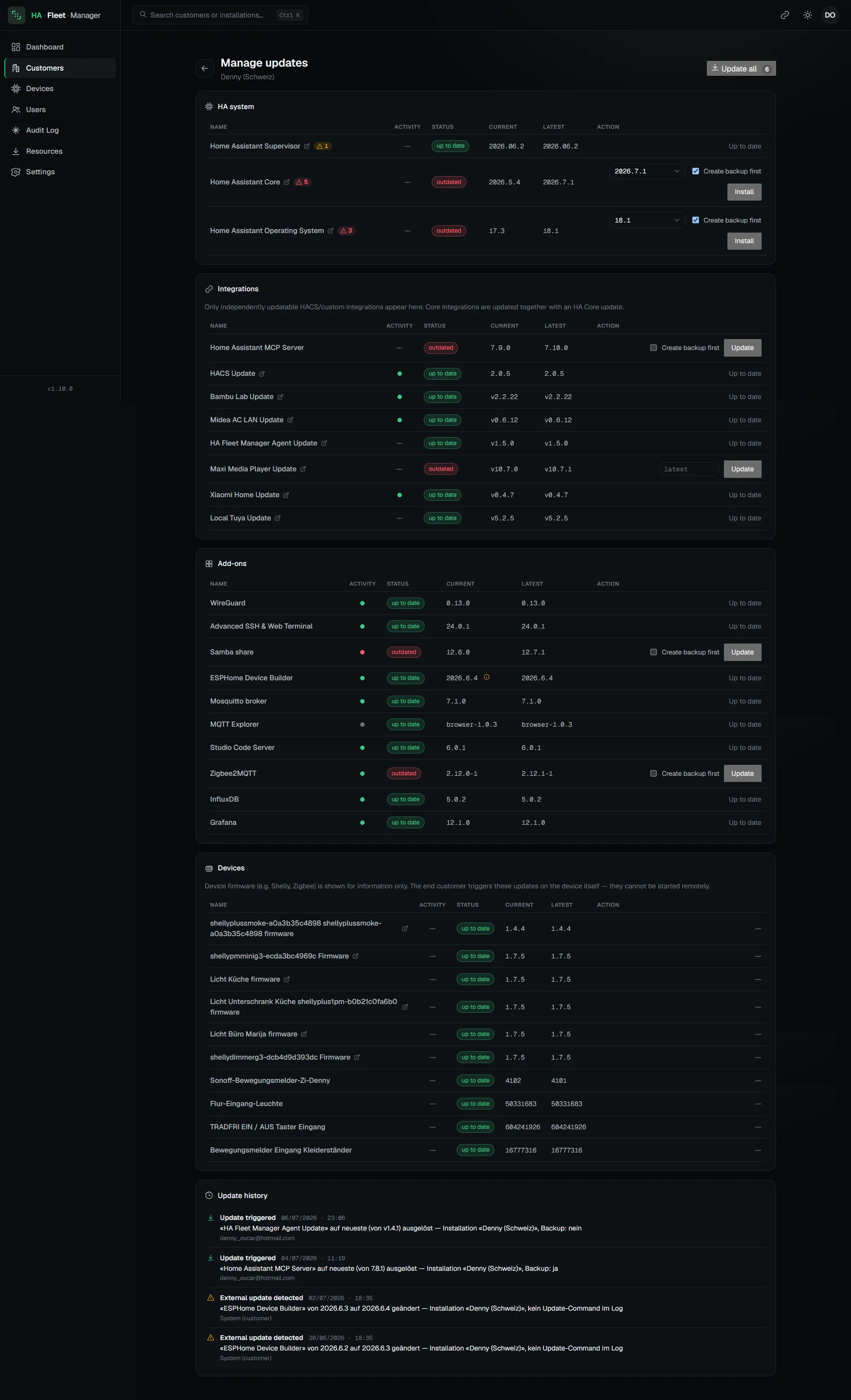
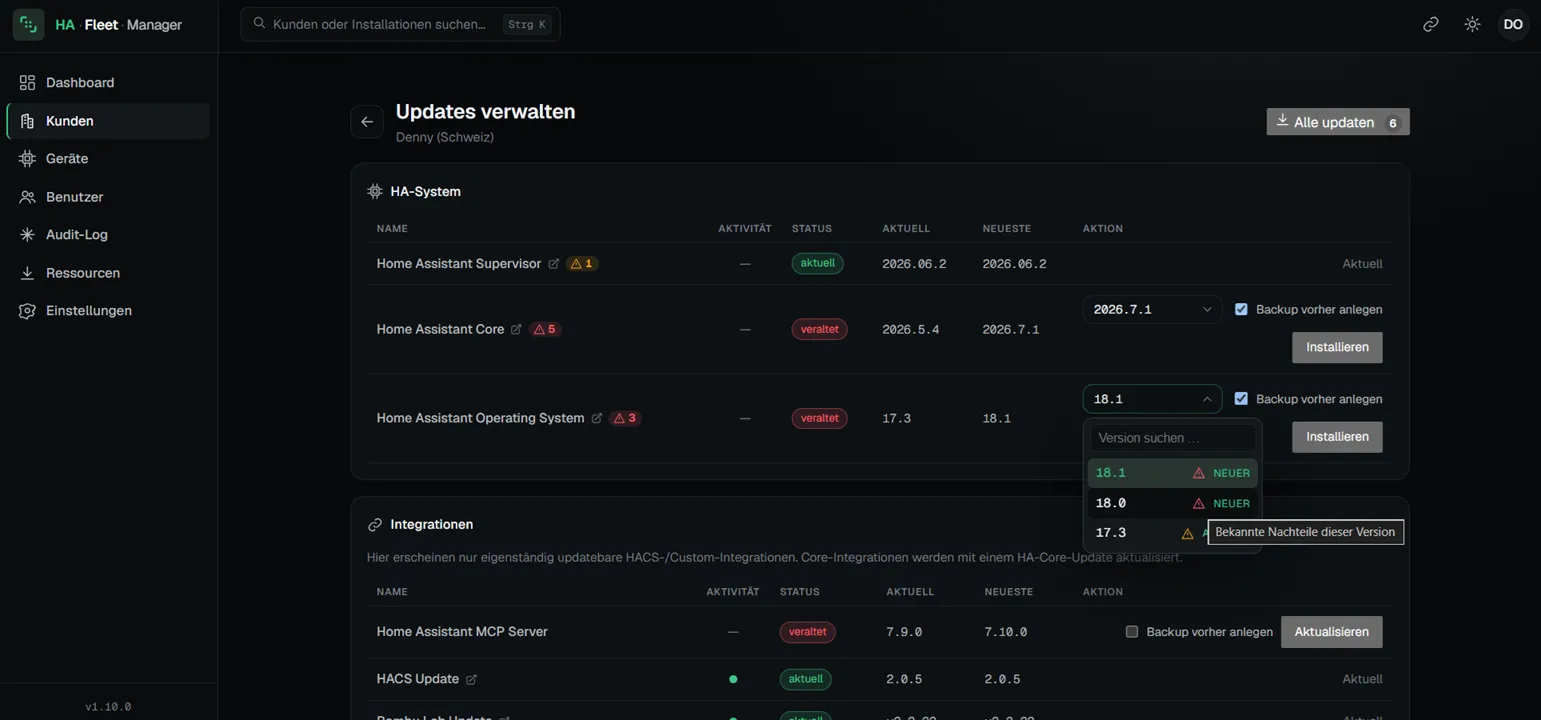
A connection to the customer system without a VPN.
No open port, no VPN at the customer's site, no router config. Everything originates from the customer, outbound only.
Five steps to access the remote system.
From the install at the customer site to the tunnel that closes itself again.
Install the plugin
A custom integration from HACS at the customer site. No port, no VPN, no router config.
Normal operation
Every 60 seconds a compact status (CPU, RAM, integrations, add-ons) is pushed to the relay.
Maintenance request
From the dashboard, with subject, reason and duration. The customer sees it as an actionable item directly inside Home Assistant.
Tunnel opens
You get a temporary URL and work in your browser on their HA, as if you were on-site.
Automatic teardown
After the agreed time the tunnel closes. The customer can also end it at any time.
Updates, remotely.
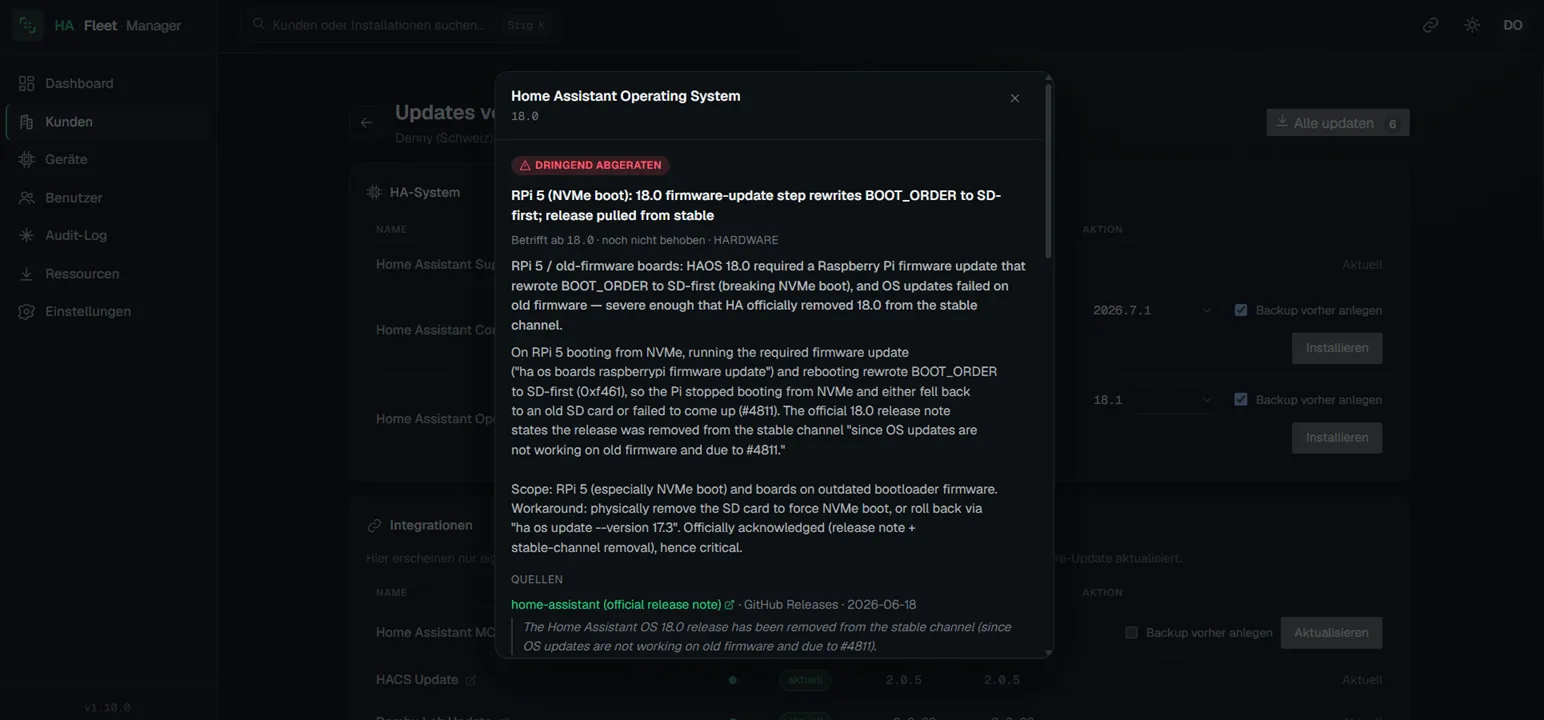
Keep your customers' Home Assistant installations current: targeted, safe and without having to log into the customer's system. What already works today:
- Update the HA system precisely Bring Core, OS and Supervisor to a chosen stable version, optionally with a backup beforehand. Risky downgrades are deliberately blocked.
- Batch add-ons & integrations Trigger add-on and HACS updates one by one or all at once via “Update all”: sequential, fault-tolerant and with no forced restart.
- Version warnings up front See a version’s known drawbacks before you install: curated and flagged by severity, right next to the version picker.
- Restart protection built in Nothing takes the HA system offline unasked: Core and OS only after explicit confirmation, never in a batch run. Device firmware stays visible but view-only.
Three sentences you've been explaining to your customers for years.
Every customer needs their own VPN setup.
WireGuard per customer, on-site router config, key rotation. Half an hour per installation, and that's just to get in.
On-site visits cost you half a day.
40 km out, "quick look", 40 km back. Fifteen minutes of work turn into four hours that eat your margin.
You hear about problems only when the customer calls.
Zigbee2MQTT has been crashing for 14 days, the heating automation hasn't run since Sunday. The customer notices Thursday evening. The call is inevitable.
What Fleet Manager does differently.
Each point closes a concrete gap that other tools leave open. None of this is marketing, it's the daily reality.
The customer decides when you log in.
Every maintenance starts with a request inside the customer's HA, with subject, reason and duration. The tunnel only opens after their click. The customer sets the duration, then it closes automatically.
Real HA depth, not generic monitoring.
Integrations, HACS, add-ons, automations, dashboards, critical logs, version, host metrics, all refreshed every 60 seconds. You see that Zigbee2MQTT has crashed before the customer notices.
Multi-tenant from day one.
One account, any number of end-customers, clean tenant isolation. Admin and technician roles. Your business scales without each new customer costing you linearly more time.
Made in Switzerland, hosted in Germany.
Hetzner Frankfurt, German UI, DACH data region. Developed in Switzerland, Swiss contract law. You never have to explain to your customer why their smart-home data lives in Oregon.
No new hardware required.
Works on any HAOS installation: Raspberry Pi, NUC, HA Yellow, HA Green, any x86 hardware. Install the plugin, paste the API key, done. It requires the Supervisor (HA OS or Supervised); plain Container or Core setups are not supported.
Duration: up to 2 hours
You see what's actually running. Not just that it's running.
Generic monitoring tools measure uptime and CPU. We measure what actually causes pain in Home Assistant: stopped integrations, broken HACS plugins, add-ons that are no longer running, critical log entries.
- All integrations tracked, per installation
- Installed add-ons visible per instance
- CPU · RAM · Disk sampled every 60 seconds
- Critical logs readable without SSH access
[zwave_js] Driver crashed: ECONNRESET
[recorder] Database is locked
Honestly small, honestly clear.
Three tiers, honestly priced. Start free, grow month by month. No annual lock-in, no hidden costs.
For power users and starters. Full feature set within the limit.
- Up to 2 systems
- 2 users
- Full monitoring feature set
- Maintenance tunnel up to 2 hrs per session
- 14-day connection history
- Updates for the HA system only
For integrators with a growing portfolio. Every feature, cancel monthly.
- Up to 4 systems
- Multiple users
- Maintenance tunnel up to 30 days
- Backups + document upload
- 30-day connection history
- Updates for add-ons & integrations
per system from the 5th on, on top of Starter (19 €/month)
For pros running many systems. The Starter base plus a fair per-system add-on.
- Everything in Starter
- System count adjustable in the app
- Billed monthly by usage
- Pay only for what you actually use
All prices per month, net, cancel monthly. No credit card needed for the Free plan.
Customers in Switzerland are billed in Swiss francs (19 CHF/month). All other countries in euros.
Made in DACH. Not as a sticker.
Our architecture is privacy-by-design. Not because some regulation demands it, but because trust is the basis of everything between you and your customer.
Hetzner Frankfurt
Data stays in the DACH region, except for selectable relay servers used for the maintenance tunnel.
Consent toggle
No access without the customer's explicit approval. Tunnel time-limited automatically.
No third-party trackers
This website sets no cookies, loads no analytics, no pixel.